

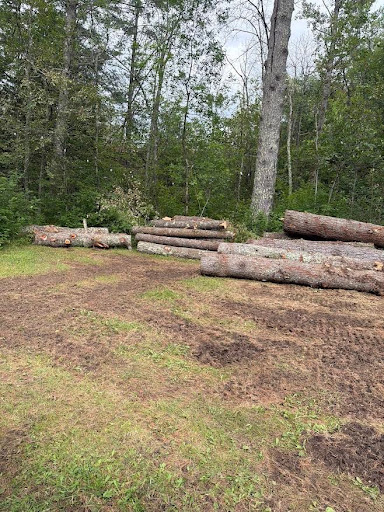
The wind finally quits. You grab your coffee, step outside, and discover the storm left you a little present you definitely did not order.
A tree is down.
Maybe it’s the maple that shaded the driveway. Maybe it’s a tall pine from the back acreage. Maybe it’s an old oak or birch that has been part of the property longer than you have.
Your first thought is probably cleanup.
Your second might be firewood.
But before the chainsaw turns that trunk into a pile of short rounds, there’s another question worth asking:
Can this fallen tree be milled into lumber?
In many cases, yes. A recently fallen tree may still contain plenty of solid, usable wood. If the trunk is large enough, relatively straight, accessible, and free from significant rot or damage, a portable sawmill may be able to turn it into boards, beams, slabs, or other lumber right on your property.
For landowners in Michigan’s Upper Peninsula and Northern Wisconsin, that can turn storm cleanup into something a whole lot more useful.
What Should You Do First When a Tree Falls After a Storm?
Before worrying about firewood, lumber, or cleanup, start with safety.
Storm-damaged trees can create hazards that aren’t always obvious from the ground. Watch for downed or nearby power lines, broken branches hanging overhead, leaning trees, split trunks, and limbs or trunks that may be under tension.
If a tree is touching or near a power line, stay away and contact the appropriate utility provider. If large limbs are hanging overhead, a tree is lodged against another tree or structure, or the trunk is under tension, professional help may be needed.
Once the tree and surrounding area have been made safe, then you can start thinking about what to do with the wood.
And this is where we’d like to save one perfectly good log from an unnecessary date with the firewood splitter.
Can a Fallen Tree Be Turned Into Lumber?
Yes. Many fallen trees can be milled into usable lumber, including trees brought down by wind, snow, saturated soil, or other storm damage.
A tree does not automatically become worthless lumber simply because it fell.
What matters is the condition of the log itself.
At HD Cuts, some of the things worth considering include:
- Diameter
- Length
- Straightness
- Tree species
- Visible rot or decay
- Cracks or major splits
- Insect damage
- Possible embedded metal
- Accessibility for milling
HD Cuts generally recommends looking at logs around 12 inches in diameter or larger as potential milling candidates, although smaller logs may sometimes be usable depending on the situation.
If you’re unsure whether yours makes the cut—pun absolutely intended—read our guide to what size logs can be milled into lumber before you start chopping the trunk into smaller pieces.
Don’t Cut the Trunk Into Firewood Yet
This is one of the most important things to know after a tree comes down.
If you think you might want to have the tree milled, don’t immediately cut the entire trunk into firewood-length sections.
A sawmill needs enough log length to produce useful boards, beams, or slabs.
Once a beautiful 10- or 12-foot sawlog has been cut into 16-inch firewood rounds, there is no putting Humpty Dumpty back together again.
Before making those cuts, look at the main trunk and consider whether it might be worth milling.
If you’re not sure, contact HD Cuts first. A quick evaluation may help you decide which portions are worth preserving for lumber and which are better suited for the woodpile.
What Storm-Damaged Trees Are Worth Milling?
Some fallen trees make better sawlogs than others.
In Michigan’s Upper Peninsula and Northern Wisconsin, common species that may be worth evaluating include:
Oak
Oak can produce strong, attractive lumber for furniture, beams, mantels, flooring, barn projects, and custom woodworking.
If a mature oak comes down during a storm, it’s worth taking a good look at the trunk before turning it into firewood.
Maple
Maple is common throughout the region and can produce beautiful lumber for tables, cabinets, shelving, countertops, furniture, and other woodworking projects.
That tree you’ve walked past 4,000 times might be hiding some pretty spectacular grain under the bark.
Pine
Large, straight pine trees can produce practical lumber for sheds, barns, framing, siding, cabins, and utility projects.
For rural property owners who already have a project in mind, a fallen pine may be material rather than debris.
Birch
Birch can produce attractive lumber for furniture and interior woodworking. A solid, recently fallen birch may be worth evaluating before it gets added to the firewood pile.
Cedar, Ash, Cherry, Walnut, and Other Species
Plenty of other local species can also produce useful lumber.
Species matters, but it isn’t the only deciding factor. Size, straightness, condition, defects, and what you ultimately want to build all matter too.
How Big Does a Fallen Tree Need to Be to Mill?
As a general guideline, logs around 12 inches in diameter or larger are often the best place to start.
Larger logs typically provide more options because there is more usable wood inside them.
For example, a larger log may be suitable for:
- Wide slabs
- Dimensional boards
- Beams
- Posts
- Mantels
- Shelving
- Furniture stock
- Barn or shed lumber
But diameter isn’t everything.
A smaller, straight, solid log may be more useful than a much larger trunk with extensive rot, severe cracking, or a hollow center.
That’s why looking at the actual log matters more than trying to make the decision based on diameter alone.
For a deeper explanation, see HD Cuts’ guide to what size logs can be milled into lumber.
How Much Lumber Can You Get From One Fallen Tree?
Potentially more than you think.
The amount of lumber a tree can produce depends on its diameter, usable length, species, straightness, defects, and how it is sawn.
A mature tree can sometimes produce hundreds of board feet of usable lumber.
That might be enough material for a workbench, shelving, furniture, a shed, beams, live-edge slabs, or part of a larger building project.
And suddenly that tree lying across the back yard looks a little different, doesn’t it?
HD Cuts has a full guide explaining how much lumber one tree can produce if you want to get a better idea of what may be hiding inside your logs.
How Soon Should a Fallen Tree Be Milled?
It’s generally better to evaluate and mill a fallen tree sooner rather than leaving the log sitting on wet ground indefinitely.
A fallen log is exposed to moisture, fungi, insects, staining, checking, and decay. How quickly those issues develop depends on the tree species, weather, where the log is lying, and its existing condition.
That doesn’t mean you need to hear a tree hit the ground and have a sawmill in the driveway before lunch.
Trees aren’t avocados. You haven’t missed the four-minute window.
But if you think the tree may be worth milling, getting it evaluated sooner can help preserve more of the usable wood.
Keeping potentially valuable logs off wet soil when practical can also help while you’re deciding what comes next.
Can Storm-Damaged Trees Still Make Good Lumber?
Absolutely.
A tree can lose branches, tip over, or even break during a storm while still having substantial usable wood in the trunk.
The important question is what happened inside the log.
A sawlog may be less suitable for milling if it has:
- Extensive internal rot
- Large hollow sections
- Severe cracks or splits
- Significant insect damage
- Major sweep or curvature
- Embedded metal
- Extensive structural damage
But don’t assume an ugly exterior means useless lumber.
Logs are a bit like people before coffee: appearances aren’t always a fair assessment of what’s going on inside.
Once the first slab comes off, the story can change quickly.
What Happens When a Portable Sawmill Comes to Your Property?
This is where portable sawmilling makes life considerably easier for rural landowners.
Instead of figuring out how to load and transport several thousand pounds of logs to a traditional mill, the portable sawmill comes to the logs.
HD Cuts provides portable sawmill services for property owners throughout Michigan’s Upper Peninsula and Northern Wisconsin.
The logs can be evaluated and milled on site into cuts appropriate for your project.
Depending on the tree and what you want to make, that could include boards, slabs, beams, posts, or other custom dimensions.
It also means the tree stays connected to the property where it grew.
An oak that came down beside the family home might become a dining table.
Pine cleared near a building site might become boards for the new shed.
A maple lost during a windstorm might become shelving, a workbench, or furniture.
That’s one of our favorite parts of portable sawmilling.
You aren’t simply getting rid of a tree.
You’re finding out what it can become.
Why Portable Sawmilling Makes Sense After a Storm
Storm cleanup already involves enough moving pieces.
Dragging heavy logs around just to figure out whether they’re usable doesn’t need to become another one.
With a portable sawmill service, logs can be processed where they already are, provided the site is accessible and suitable for milling.
For rural properties, farms, wooded acreage, cabins, and homes throughout the Upper Peninsula and Northern Wisconsin, that can make salvaging storm-damaged trees much more practical.
It also gives landowners more control over how their own trees are used.
Instead of watching decades of growth disappear into a burn pile, the wood can stay on the property for years to come.
What Can You Build With Lumber From a Fallen Tree?
Quite a bit.
Depending on the species, size, quality, drying requirements, and how the log is milled, your lumber might eventually become:
- A workbench
- Shed or barn boards
- Cabin beams
- Shelving
- Tables
- Benches
- Mantels
- Live-edge slabs
- Furniture
- Siding
- Posts
- Custom woodworking projects
There is something especially satisfying about answering, “Where did you get the wood for that?”
“That old maple by the driveway.”
That’s a much better ending to the story than, “We burned it.”
Is It Worth Milling a Fallen Tree Instead of Using It for Firewood?
A fallen tree may be worth milling when the trunk is large, straight, solid, accessible, and capable of producing lumber you’ll actually use.
Firewood is still a perfectly good use for many trees. This is the U.P. and Northern Wisconsin, after all. Nobody here is picking a fight with the woodpile.
But larger, higher-quality logs deserve a second look.
Before splitting them, consider three questions:
- Is the trunk large and solid enough to mill?
- Could I use boards, beams, slabs, or posts for a future project?
- Would bringing a portable sawmill to the property be easier than moving the logs?
If you’re answering yes—or even “maybe”—it makes sense to find out what you have before cutting it smaller.
Where Does HD Cuts Provide Portable Sawmill Service?
HD Cuts provides portable sawmilling throughout Michigan’s Upper Peninsula and Northern Wisconsin, including areas around Iron Mountain, Marquette, Escanaba, Houghton, Ironwood, Munising, Menominee, Rhinelander, Eagle River, Minocqua, Woodruff, Hurley, Mercer, Boulder Junction, and surrounding communities.
If you’ve had trees come down after a windstorm, snowstorm, or other severe weather in the region, HD Cuts can help determine whether your logs may be suitable for milling.
Common Questions About Fallen Trees and Portable Sawmilling
What should I do with a fallen tree after a storm?
Start by checking for safety hazards such as power lines, hanging limbs, unstable trees, structures, and tensioned wood. Once the site has been made safe, decide whether the trunk is worth preserving for lumber before cutting it into firewood-sized pieces.
Can a tree that fell in a storm be used for lumber?
Yes. A storm-damaged tree can often be milled if the trunk contains solid usable wood and is large enough and accessible for sawmilling.
Should I cut a fallen tree into logs before calling a portable sawmill?
Not necessarily. If you want lumber, contact the sawmill before cutting the entire trunk into short sections. Preserving adequate log length gives you more options for boards, beams, slabs, and other cuts.
What size fallen tree is worth milling?
Logs around 12 inches in diameter or larger are often good candidates for evaluation, although condition, length, straightness, species, and the intended project also matter.
Can HD Cuts mill a fallen tree at my property?
Yes. HD Cuts offers portable sawmill service throughout Michigan’s Upper Peninsula and Northern Wisconsin, allowing suitable logs to be milled on site rather than transported to a traditional sawmill.
How long can a fallen tree sit before milling?
There isn’t one deadline for every tree. Species, moisture, ground contact, insects, weather, and existing damage all affect deterioration. In general, it’s smart to have potentially valuable logs evaluated sooner rather than letting them remain on wet ground for an extended period.
Before That Fallen Tree Becomes Firewood, Find Out What’s Inside
After a northern storm, a fallen tree can feel like one more mess to deal with.
Sometimes it is.
But sometimes that oak, maple, pine, birch, cedar, or other tree lying across the property is also a stack of boards waiting to happen.
Before cutting a large, solid trunk into firewood, give HD Cuts a chance to take a look.
HD Cuts Portable Sawmilling brings the mill directly to properties throughout Michigan’s Upper Peninsula and Northern Wisconsin, turning suitable logs into usable lumber right where the trees came down.
That storm may have decided when the tree came down.
You still get to decide what happens to the wood next.