

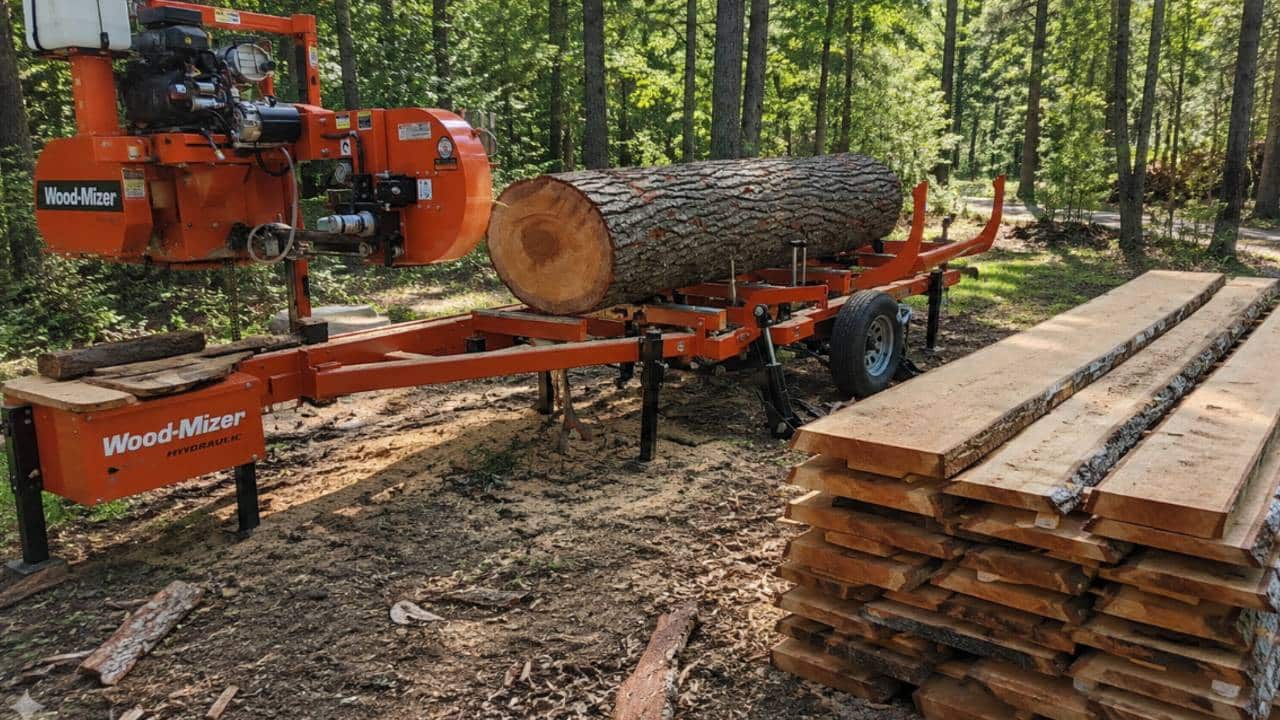
A single mature tree can produce anywhere from 100 to more than 1,000 board feet of lumber, depending on its diameter, height, species, and condition. For many landowners in Michigan’s Upper Peninsula and Northern Wisconsin, that means a storm-damaged oak, maple, pine, or walnut may be worth far more as usable lumber than as a pile of firewood.
It usually starts with a tree coming down.
Maybe a storm rolls through overnight. Maybe an old maple finally gives up beside the driveway. Maybe an oak at the edge of the field has been leaning a little harder every year until one morning it is stretched across the grass like it got tired of standing.
The first thought is usually cleanup.
Then firewood.
Then, if someone in the group has a little sawdust in their soul, comes the better question:
“How much lumber could we get out of that tree?”
That question is worth asking before the chainsaw turns the whole thing into stove-length pieces. Because inside that rough bark could be enough lumber for a table, beams, shelving, a shed, a cabin project, or custom boards you would pay good money for at a lumberyard.
And the best part? With portable sawmill services, the tree does not have to leave your property to become something useful.
What Is a Board Foot?
Lumber is usually measured in board feet.
One board foot equals a piece of wood that is:
- 1 inch thick
- 12 inches wide
- 12 inches long
So, if you have a board that is 1 inch thick, 6 inches wide, and 8 feet long, that board contains 4 board feet.
Board feet measure volume, not the number of boards. That matters because one tree can be cut into many different sizes depending on the project.
The same log might become:
- wide live-edge slabs
- 1-inch boards
- 2-inch thick lumber
- beams
- posts
- mantle pieces
- trailer decking
- barn material
That is why sawmills estimate lumber by volume first. The final board count depends on how the tree is milled.
According to forestry extension resources, board foot estimates are commonly calculated using log rules such as Doyle, Scribner, and International 1/4-inch, and each one can produce different estimates for the same log. Virginia Cooperative Extension notes that a 12-inch log may scale at 95 board feet using International, 80 using Scribner, and 64 using Doyle.
Tiny detail? Nope. That difference is exactly why a professional sawmill evaluation matters.
How Much Lumber Can One Tree Produce?
A small tree may only produce 50 to 100 board feet of lumber. A large, straight hardwood tree can produce several hundred board feet. A very large, high-quality tree can produce 1,000 board feet or more.
Here is a general estimate:
| Tree Diameter | Approximate Lumber Yield |
| 12 inches | 50–100 board feet |
| 16 inches | 100–200 board feet |
| 20 inches | 200–350 board feet |
| 24 inches | 350–500 board feet |
| 30 inches | 600–1,000+ board feet |
These are not guarantees. They are realistic ballpark ranges.
A 24-inch tree with a straight trunk and healthy wood can produce far more usable lumber than a crooked 24-inch tree with rot, metal, cracks, or heavy branching.
Still, the main point stands:
Bigger trees do not produce just a little more lumber. They can produce dramatically more lumber because volume increases quickly as diameter increases.
That is why a mature oak, maple, pine, or walnut deserves a second look before it gets split for firewood.
Why Tree Diameter Changes Everything
Diameter is one of the biggest factors in lumber yield.
A 12-inch tree may be useful, but it has limited board width and less usable center wood. A 24-inch tree opens up more possibilities. A 30-inch tree can produce wider boards, thicker slabs, beams, and higher-value custom cuts.
This is where many landowners underestimate what they have.
A tree may not look impressive when it is lying in the yard covered in bark, mud, and branches. But once it is cut into logs and rolled onto a mill, the math changes.
One large hardwood tree can become a serious stack of lumber.
And for property owners across the Upper Peninsula and Northern Wisconsin, that can mean saving money on materials while keeping the story of the tree right there on the property.
Species Matters: Oak, Maple, Pine, Walnut, and More
The kind of tree affects both the amount and the usefulness of the lumber.
Oak
Oak is one of the most popular hardwoods for milling. It is strong, durable, and beautiful when finished.
Common uses include:
- dining tables
- mantels
- beams
- cabinetry
- flooring
- furniture
- barn projects
A mature oak tree can often produce hundreds of board feet of lumber. Large oak logs may also produce slabs with strong grain character.
Maple
Maple is common throughout Michigan’s Upper Peninsula and Northern Wisconsin, and it can make beautiful, durable lumber.
It is often used for:
- tables
- countertops
- cutting boards
- cabinets
- shelving
- furniture
Hard maple can be especially valuable for woodworking projects because of its strength and clean appearance.
Pine
Pine may not have the same premium reputation as walnut or oak, but do not dismiss it. Large pine logs can produce excellent practical lumber.
Pine is commonly used for:
- sheds
- barns
- framing
- siding
- utility boards
- rustic interior projects
For landowners planning outbuildings, cabins, or farm projects, pine can be a great candidate for milling.
Walnut
Walnut is one of the most desirable hardwoods for furniture and custom work. It has rich color, strong character, and high visual appeal.
A quality walnut log can be worth evaluating carefully before making any cuts.
Ash, Birch, Cherry, and Other Local Woods
Other regional species can also be worth milling depending on size, condition, and intended use. Ash, birch, cherry, cedar, hemlock, and other woods can all have practical or decorative value.
The best question is not always, “Is this tree valuable?”
A better question is:
“What could this tree become?”
What Makes a Tree Worth Milling?
Not every tree is a great milling candidate. Some trees are better as firewood, and that is perfectly fine.
A tree is more likely to be worth milling if it has:
- a trunk diameter of 16 inches or more
- a long, straight section
- minimal rot
- limited metal damage
- fewer large knots
- desirable species
- enough length for usable logs
- a project in mind
The best logs are usually straight, solid, and clean.
But here is the part that surprises people: a tree does not have to be perfect to be useful.
A log with knots may still make gorgeous rustic lumber. A tree with some defects may still produce short boards, slabs, mantels, or specialty pieces. Even unusual grain can become a feature, not a flaw.
Wood is funny like that. Sometimes the “imperfections” are the whole personality.
What Reduces Lumber Yield?
A tree can look impressive from the outside and still produce less lumber than expected.
Common issues that reduce yield include:
- internal rot
- hollow sections
- cracks
- embedded nails, fencing, or hardware
- severe sweep or curve
- heavy branching
- insect damage
- large knots
- stain or decay
Metal is a big one.
Trees near old fence lines, barns, yards, deer stands, clotheslines, or farm areas sometimes contain nails, wire, hooks, screws, or other surprises. Sawmill blades do not enjoy those surprises. Nobody enjoys those surprises. It is very much a “well, there goes the peaceful afternoon” situation.
This is one reason professional evaluation matters. A sawmill operator knows what to look for before milling begins.
Why Log Rules Can Give Different Answers
If you start researching “how many board feet are in a log,” you will quickly run into several different log scales.
The most common include:
- Doyle Log Rule
- Scribner Log Rule
- International 1/4-Inch Rule
These scales estimate how much lumber a log may produce, but they do not always agree.
Purdue Extension explains that the Doyle Rule often underestimates smaller logs, while accuracy improves as log diameter increases. Scribner can be closer in some cases, and International 1/4-inch is often used as a more consistent comparison standard.
The U.S. Forest Service also notes that log rules vary because they assume different losses for slabs, saw kerf, shrinkage, and other milling factors.
In plain English?
The number depends on how it is measured.
That is why online calculators are useful for rough estimates, but they cannot replace someone looking at the actual log.
Firewood vs. Lumber: Which Is the Better Use?
Firewood has its place. Around here, nobody is disrespecting a good woodpile.
But some logs deserve better than being split and burned.
A mature hardwood tree cut into firewood may provide heat for a season. That same tree milled into lumber could become:
- a dining table your family uses for decades
- beams for a cabin
- shelving for a home or shop
- boards for a shed
- a mantle over the fireplace
- lumber for woodworking projects
- custom slabs for resale or personal use
One option turns the tree into heat.
The other turns it into something lasting.
That difference matters.
Especially when the tree has history.
Maybe your kids played under it. Maybe it stood beside the farmhouse. Maybe it came down in a storm and you hated seeing it go.
Milling gives that tree a second life.
And yes, that sounds a little sentimental. We are okay with that. Some wood is just wood. Some wood comes with a story.
Can One Tree Provide Enough Lumber for a Whole Project?
Yes, sometimes one tree can provide enough lumber for an entire project.
Depending on the size and species, one tree may produce enough material for:
- a large dining table
- multiple benches
- a set of shelves
- a mantle
- a workbench
- barn boards
- cabin beams
- shed framing
- live-edge slabs
- custom furniture
A single large hardwood tree can surprise you.
The boards start stacking beside the mill, and suddenly the project feels real.
What looked like one fallen tree turns into actual material. Not theory. Not “someday.” Actual lumber you can measure, stack, dry, and use.
That is one of the biggest reasons people call a portable sawmill. They are not just trying to get rid of logs. They are trying to see what is possible.
Why Portable Sawmilling Makes Sense for Rural Properties
In the past, getting logs milled often meant hauling them to a commercial sawmill.
That could require:
- heavy equipment
- a trailer
- extra labor
- time
- fuel
- coordination
- safe loading and unloading
For many landowners, that was enough hassle to make firewood seem like the only realistic option.
Portable sawmills changed that.
Instead of hauling the logs to the mill, the mill comes to the logs.
For property owners in the Upper Peninsula of Michigan and Northern Wisconsin, this is a practical advantage. Rural properties often have acreage, long driveways, wooded lots, storm-damaged trees, or cleared areas where logs are already sitting.
Portable milling makes it possible to turn those logs into lumber right on-site.
That means:
- less log handling
- no long-distance hauling
- more control over cuts
- custom dimensions
- better use of your own timber
- immediate visibility into the yield
It is efficient, practical, and honestly pretty satisfying to watch.
There is something about seeing rough logs become clean boards on your own property that hits differently.
What Happens During the Milling Process?
The process starts with evaluating the logs.
The sawmill operator looks at:
- diameter
- length
- species
- straightness
- visible defects
- rot
- cracks
- knots
- metal risk
- project goals
Then the log is positioned on the mill.
The first cut removes the outer slab. That is often the moment when the character of the wood starts to show.
From there, the operator makes decisions based on the log and the desired final product.
Some logs are best cut into dimensional lumber.
Others are better suited for slabs.
Some are ideal for beams.
Some make better short boards.
Good milling is part math, part experience, and part reading what the log wants to give.
That last part may sound a little mystical, but anyone who has milled enough logs knows it is true. The grain, shape, defects, and species all guide the cut.
Should You Mill a Dead Tree?
Sometimes, yes.
A dead tree may still be millable if the wood is solid and not too far gone.
The key factors are:
- how long it has been dead
- whether it is standing or lying on the ground
- whether rot has started
- whether insects have damaged it
- whether the trunk is still structurally sound
A recently dead standing tree may still produce good lumber.
A tree that has been lying on wet ground for years may have significant decay.
The sooner you evaluate the tree, the better.
That does not mean you need to panic. Trees are not bananas. They do not go from perfect to useless overnight.
But waiting too long can reduce yield.
Do You Need to Dry the Lumber After Milling?
Yes. Fresh-cut lumber is green, meaning it still contains moisture.
Before using it for furniture, interior projects, or many building applications, lumber usually needs to dry.
Drying can happen through:
- air drying
- kiln drying
- a combination of both
Air drying takes time. A common rule of thumb is about one year per inch of thickness, depending on airflow, stacking, climate, and wood species.
Freshly milled boards should be stacked properly with stickers between layers so air can move through the pile. They also need weight or restraint to reduce warping.
This is another area where guidance helps. Milling the tree is step one. Handling the lumber correctly afterward protects the value of what you just created.
How to Know If You Should Call HD Cuts Before Cutting a Tree Up
Call before cutting everything into short rounds.
That is the big one.
Once a tree is cut into firewood lengths, many milling options disappear. A sawmill needs usable log length to create boards, slabs, beams, or dimensional lumber.
Before you start bucking the trunk into small pieces, pause and look at the tree.
It may be worth calling HD Cuts if:
- the tree is 16 inches or larger in diameter
- the trunk has straight sections
- the log is 8 feet or longer
- the species is oak, maple, pine, walnut, ash, cherry, cedar, or another usable wood
- you want lumber for a project
- you are clearing property
- storm damage left large logs behind
- you are unsure whether it is worth milling
Even if the answer is “this one is better for firewood,” at least you will know before the opportunity is gone.
Frequently Asked Questions About Lumber From One Tree
How much lumber can one tree produce?
One tree can produce anywhere from 50 to more than 1,000 board feet of lumber depending on its diameter, height, species, and condition. Large, straight hardwood trees often produce several hundred board feet.
How many board feet are in an oak tree?
A mature oak tree may produce 200 to 1,000+ board feet depending on size and quality. A large, straight oak with multiple usable log sections can produce a substantial amount of lumber.
What size tree is worth milling?
Trees 16 inches or larger in diameter are often worth evaluating. Smaller trees can still be useful for certain projects, but larger logs generally provide better yield and more cutting options.
Can a portable sawmill come to my property?
Yes. HD Cuts provides portable sawmill services that allow logs to be milled directly on-site throughout Michigan’s Upper Peninsula and Northern Wisconsin.
Is it better to mill a tree or turn it into firewood?
It depends on the tree. Firewood is useful, but a large, straight hardwood may have more long-term value as lumber, slabs, beams, or custom boards.
Can storm-damaged trees be milled?
Often, yes. If the trunk is solid and has usable sections, a storm-damaged tree may still be a great candidate for milling.
Can dead trees be milled?
Sometimes. Recently dead trees may still produce good lumber if the wood is solid. Trees with advanced rot or insect damage may have reduced yield.
What trees produce the most lumber?
Large, straight trees with minimal defects produce the most usable lumber. Oak, maple, pine, walnut, ash, cherry, and other regional species can all be good candidates depending on condition.
How long should logs be for milling?
Logs are often milled in lengths such as 8, 10, 12, or 16 feet, depending on the project and equipment. Longer straight logs usually provide more flexibility.
Do I need a project in mind before milling?
Not always, but it helps. Knowing whether you want slabs, beams, boards, or framing lumber allows the sawmill operator to cut the log in the most useful way.
The Lumber for Your Next Project Might Already Be on Your Property
Most people look at a fallen tree and see work.
Branches to clear.
Logs to cut.
A mess to deal with.
But sometimes, that fallen tree is not just a cleanup job. Sometimes it is the beginning of a table, a cabin beam, a workbench, a stack of boards, or a project you have not even imagined yet.
Before you turn a large tree into firewood, it is worth asking what it could become.
HD Cuts helps landowners throughout Michigan’s Upper Peninsula and Northern Wisconsin turn logs into usable lumber with portable sawmill services brought directly to your property. If you have a downed tree, storm-damaged logs, or standing timber you are considering using, reach out before you cut it small. The lumber for your next project may already be waiting in your yard.
Sources
Virginia Cooperative Extension, Purdue Extension, and U.S. Forest Service resources were used to support board foot and log scale information.