

It doesn’t take long before someone asks me the same question.
“Hunter, what trees make the best lumber around here?”
The short answer is maple, oak, pine, cedar, and even birch. We have some incredible timber growing throughout Michigan’s Upper Peninsula and Northern Wisconsin. The “best” tree really depends on what you want to build, but one thing I’ve learned over the years is this—most people have no idea what’s sitting on their own property until we make that first cut.
I’ve lost track of how many times I’ve heard someone say, “I was just going to cut it up for firewood.”
Sometimes that’s the right decision.
Sometimes it isn’t.
And that’s exactly why I enjoy what I do.
A while back, I pulled into a customer’s driveway after he called about a tree that had come down during a heavy spring snowstorm. Like a lot of folks, he’d already cleaned up the branches and stacked the smaller pieces for firewood. The trunk, though, had been sitting off to the side for months because he wasn’t quite sure what to do with it.
As we walked over to it, he shrugged and said, “Figured I’d haul it away one of these weekends.”
I took one look and smiled.
“It might be worth taking a closer look first.”
By the end of the day, that log wasn’t headed for the burn pile anymore.
It was stacked neatly into beautiful boards, and instead of talking about getting rid of it, he was talking about building a workbench for his garage.
That’s the kind of transformation I get to see all the time.
It’s one of the reasons I enjoy sharing these stories here on the HD Cuts Blog. Every property is different, every milling job has its own challenges, and every once in a while there’s a tree that completely surprises the homeowner. If you’ve been following along with some of the other projects I’ve shared, you know that’s part of what makes portable sawmilling so rewarding.
Why Some Trees Make Better Lumber Than Others
One question usually leads to another.
“So…what makes one tree better than another?”
The answer isn’t always about the species.
When I look at a log, I’m paying attention to several things before it ever rolls onto the mill.
Is the trunk straight?
Has it been sitting on the ground too long?
Are there signs of rot?
How large is the diameter?
What does the grain look like?
Those things all play a part in how much usable lumber comes out of a log.
Of course, the type of tree matters too.
Some species produce dense hardwood that’s perfect for furniture and heavy-duty projects. Others create lighter lumber that’s ideal for framing, sheds, garages, and cabins.
After milling logs across Michigan’s Upper Peninsula and Northern Wisconsin, there are a handful of species I always enjoy seeing come through the mill.
Maple: One of Michigan’s Best Hardwoods
That tree from the story?
It turned out to be maple.
As soon as the first clean board came off the mill, the homeowner walked over and ran his hand across it.
“I never would’ve guessed it looked like that inside.”
Honestly, neither of us ever gets tired of that moment.
Maple is one of the most versatile hardwoods you’ll find anywhere in northern Michigan or Wisconsin. It’s strong, mills beautifully, and works well for everything from cabinets and flooring to furniture, countertops, and workbenches.
One of the things I love most about milling maple is that every log has its own personality. Sometimes the grain is clean and straight. Other times you’ll uncover curly grain or beautiful figuring that was completely hidden beneath the bark.
That’s why I always tell people not to judge a tree by the outside.
You never really know what’s inside until the blade starts cutting.
And when customers see those first few boards, that’s usually when the ideas start flowing.
“That’d make a nice dining room table.”
“I’ve been wanting a new workbench.”
“Those shelves would look great in the cabin.”
The conversation changes almost immediately because they’re no longer looking at a fallen tree.
They’re looking at possibilities.
Oak Has Been Building the North for Generations
One of the questions I get after talking about maple is usually,
“What about oak?”
If you’ve got healthy oak on your property, you’ve got one of the toughest hardwoods growing in the Midwest.
There’s a reason so many old barns, timber-frame buildings, and hunting camps around the Upper Peninsula are still standing decades later.
Oak is incredibly durable.
It’s heavy.
It’s strong.
And when it’s milled properly, it produces beautiful lumber that’s built to last.
I always tell customers that oak isn’t just lumber for today’s project.
It’s lumber your kids and grandkids will probably still be using.
Whether it’s heavy beams, hardwood flooring, furniture, mantels, or a custom dining table, oak has earned its reputation for a reason.
The funny thing is, a lot of people don’t realize they have quality oak until they’re deciding whether to clean up storm damage or clear a section of their property.
That’s why I always encourage folks to ask before cutting everything into firewood.
Sometimes one conversation can save a tree that’s worth far more as lumber than it ever would be heating the wood stove.
If you’re ever unsure what species you have or whether it’s worth milling, I’d rather answer the question before the chainsaw starts cutting. Every property is different, and it only takes a few minutes to look at a log and give you an honest opinion.
Pine and Cedar Deserve a Spot on the List, Too
By the time we’d finished milling that maple, the homeowner looked over toward another section of his property and pointed to a line of trees.
“What about those?”
I hear that question almost every time I’m on a job.
The truth is, maple isn’t the only tree worth saving.
Pine: The Underrated Workhorse
Pine may not have the reputation of maple or oak, but don’t overlook it.
If you’re building a garage, a pole barn, a hunting blind, a shed, or even framing out a cabin, pine produces excellent lumber. Around Michigan’s Upper Peninsula and Northern Wisconsin, it’s one of the most common species I mill because it grows tall, straight, and provides long, usable boards.
One thing that surprises a lot of homeowners is just how much lumber comes from a healthy pine tree.
I’ve had customers stare at the growing stack of boards and say,
“I had no idea we’d get that much out of one tree.”
That’s why it’s worth asking before you decide to haul it away or cut it into firewood.
Cedar: Built for the Outdoors
Then there’s cedar.
Anyone who’s been around fresh-cut cedar knows exactly what I’m about to say.
Nothing beats that smell.
The moment the blade starts cutting, the whole job site changes. It’s one of those things that never gets old, no matter how many cedar logs I’ve milled.
But cedar isn’t just enjoyable to work with—it has a job to do.
Because it naturally resists moisture, insects, and decay, cedar has been a favorite for generations when it comes to:
- Fencing
- Cabin siding
- Outdoor furniture
- Pergolas
- Decorative beams
- Garden projects
Living where we do, that’s a pretty big advantage.
Whether you’re building something that’ll sit out in the weather or adding character to your property, cedar is hard to beat.
I’ve shared a few cedar milling jobs and other customer projects here on the HD Cuts Blog, and they’re some of my favorites because it’s always rewarding to see what people build after the milling is finished.
So…How Do You Know if Your Trees Are Worth Milling?
This is probably the question I get asked more than any other.
“Hunter, how do I know if the trees on my property are worth milling?”
The honest answer is…
It depends.
I’ve seen storm-damaged trees produce beautiful lumber.
I’ve also looked at perfectly healthy trees that simply weren’t good candidates.
Every log is different.
When I come out to a property, I’m looking at things like:
- The species
- The size of the log
- How straight it is
- Whether there’s rot or damage
- How long it’s been on the ground
- What you’re hoping to build
Sometimes the answer is yes.
Sometimes I’ll tell you it isn’t worth your money.
I’d rather be honest than have someone expect something a log can’t deliver.
That’s one thing my customers appreciate.
If it’s worth milling, I’ll tell you.
If it isn’t, I’ll tell you that too.
If you’re not sure whether your trees are good candidates, contact me before you cut them into firewood. I’m always happy to take a look and give you an honest opinion.
Why More Landowners Are Choosing Portable Sawmilling
Years ago, if you wanted lumber from your own trees, you had to haul those logs to a commercial mill.
For a lot of folks, that meant borrowing trailers, finding equipment, and hoping someone else could fit the job into their schedule.
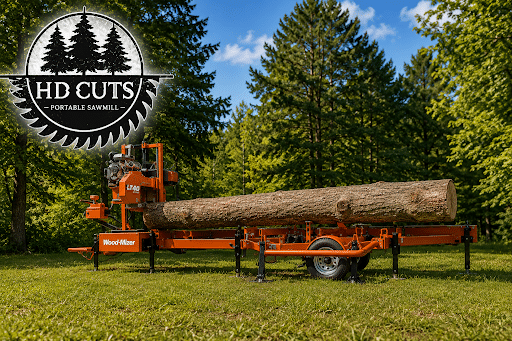
Portable sawmills changed all of that.
Instead of moving the logs…
I bring the mill to you.
That means your trees stay on your property, and you get to watch them become lumber right where they grew.
There’s something pretty satisfying about seeing the whole process happen in your own backyard.
You know exactly where your lumber came from.
You know how it was cut.
And before the day is over, you’re already thinking about the projects those boards will become.
If you’ve been reading some of the stories here on the HD Cuts Blog, you’ve probably noticed that’s my favorite part of every job. Every pile of lumber has a future. Whether it’s a hunting camp, a family cabin, a workshop, or a barn, every project starts with someone deciding a tree was worth saving.
The Tree Was Never Just a Tree
As I started loading up that afternoon, the homeowner walked over one last time and looked at the stack of maple boards.
He laughed and shook his head.
“You know… this morning I was planning to burn that thing.”
I smiled.
“I’ve heard that before.”
Honestly…
I’ve heard it more times than I can count.
That’s why I enjoy this work.
Sure, I like running the sawmill.
I like the smell of fresh-cut cedar.
I like watching logs turn into lumber.
But what I really enjoy is helping people see what’s been sitting on their property all along.
Sometimes it’s not just a fallen tree.
It’s the lumber for a garage you’ve wanted to build.
The workbench you’ve been talking about for years.
The table your family will gather around.
Or the cabin your grandkids will someday remember.
Every tree has a story.
Sometimes all it needs is someone willing to make the first cut.
Frequently Asked Questions
What trees make the best lumber in Michigan and Wisconsin?
Maple, oak, pine, cedar, and birch are some of the best trees for milling throughout Michigan’s Upper Peninsula and Northern Wisconsin. The best choice depends on what you’re building, but each species has its own strengths.
Is it worth milling trees from my own property?
Many times, yes. Healthy trees can often be turned into quality lumber for garages, barns, cabins, furniture, and other projects. The easiest way to know is to have them looked at before they’re cut up for firewood.
Can HD Cuts mill trees on my property?
Absolutely. HD Cuts provides portable sawmilling throughout Michigan’s Upper Peninsula and Northern Wisconsin, bringing the sawmill directly to your property so your logs don’t have to leave home.
What can I build with lumber from my own trees?
Customers have used their lumber for hunting blinds, garages, barns, workshops, live-edge furniture, cabin interiors, shelving, fencing, and countless other projects. That’s one of the best parts of portable sawmilling—you’re building with wood that came from your own land.
Sometimes the Best Lumber Is Already Growing on Your Property
If you’ve got trees on your property and you’ve been wondering whether they’re worth milling, I’d be happy to take a look. Sometimes one conversation can save a log that turns into something your family will use for generations.
If you’re ready to see what’s possible, contact HD Cuts to talk about your next portable sawmilling project. And while you’re here, spend a little time exploring the other stories on the HD Cuts Blog. You’ll find real projects, milling tips, and ideas from jobs all across Michigan’s Upper Peninsula and Northern Wisconsin. You never know—you might find the inspiration for your next project, or realize the lumber you’ve been looking for has been growing in your own backyard all along.