

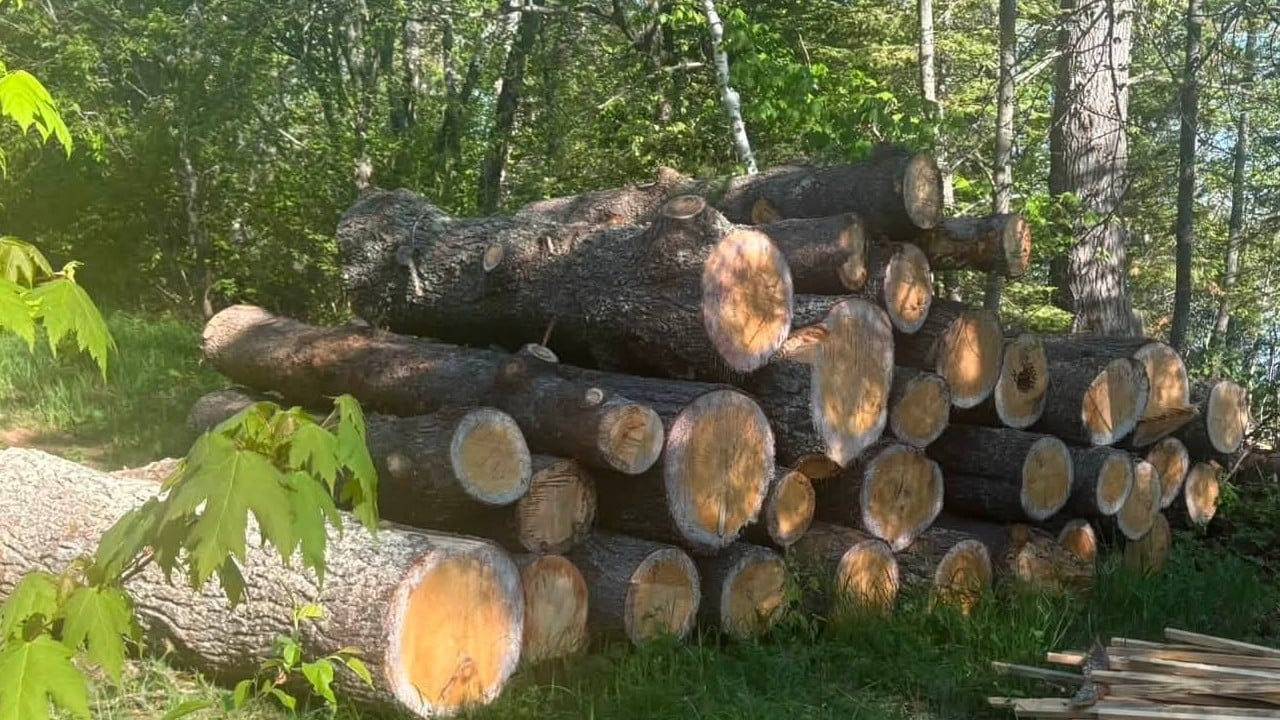
A storm rolls through overnight.
The wind howls. Branches snap. The rain pounds the roof hard enough to keep you awake.
The next morning, coffee in hand, you step outside and immediately see it.
A tree is down.
Maybe it’s an oak that has stood on your property longer than you’ve owned it. Maybe it’s a maple shading your driveway. Maybe it’s a pine that finally gave in after years of battling northern Wisconsin winters.
At first, the conversation usually sounds the same.
“We’ll cut it up.”
“Guess it’ll make good firewood.”
Then someone asks a question that changes everything.
“Could we mill it into lumber?”
Suddenly, that fallen tree isn’t just cleanup anymore.
It’s potential.
And that’s when most property owners start asking the same question:
What size logs can actually be milled into usable lumber?
The short answer is that most logs measuring 12 inches in diameter or larger can be milled into usable boards. However, size is only one piece of the puzzle. The species, straightness, condition, and length of the log all affect how much lumber can be produced and whether milling makes sense.
Let’s take a closer look.
The Minimum Log Size Most Sawmills Can Work With
In general, logs should be at least 10 to 12 inches in diameter before milling becomes practical.
At that size, a sawmill can begin producing boards wide enough for common woodworking and construction projects.
As the diameter increases, so do your options.
A 12-inch log may produce several useful boards.
A 16-inch log can often produce significantly more dimensional lumber.
A 24-inch log may yield wide slabs, large beams, and a substantial amount of board footage.
The larger the log, the greater the lumber yield.
For property owners in Michigan’s Upper Peninsula and Northern Wisconsin, many mature hardwoods easily exceed these minimum dimensions.
How Much Lumber Can One Tree Produce?
This is one of the most common questions portable sawmill operators hear.
The answer depends on species, diameter, height, and overall condition.
A mature hardwood tree can sometimes produce hundreds of board feet of lumber.
For example:
- A 16-inch diameter log may yield 80–150 board feet
- A 20-inch diameter log may yield 150–250 board feet
- A 24-inch diameter log may yield 250+ board feet
According to forestry yield estimates used throughout the lumber industry, larger hardwood logs often produce dramatically more usable lumber than property owners expect.
That’s why experienced sawyers don’t immediately see firewood when they look at a fallen tree.
They see lumber hiding inside.
Size Matters. But Straightness Matters More.
Imagine trying to cut perfectly straight boards from a banana.
That’s essentially what happens with severely curved logs.
The highest-value logs are usually:
- Straight
- Solid
- Free from extensive rot
- Free from large cracks or splits
Straight logs allow consistent cuts and maximize usable lumber.
Crooked logs can still be milled, and sometimes produce beautiful specialty pieces, but they generally create more waste and shorter boards.
If your goal is dimensional lumber for building projects, straight logs are typically the best candidates.
The Best Trees to Mill in Michigan and Northern Wisconsin
The forests of the Upper Peninsula and Northern Wisconsin are full of species that produce exceptional lumber.
Oak
Oak remains one of the most valuable species for milling.
It is known for:
- Strength
- Durability
- Attractive grain patterns
- Structural performance
Oak lumber is commonly used for furniture, flooring, beams, barns, and custom woodworking projects.
Maple
Maple is one of the region’s most abundant hardwoods.
It produces beautiful lumber frequently used for:
- Cabinets
- Furniture
- Flooring
- Custom wood projects
Many property owners are surprised by the striking grain patterns revealed after milling.
Pine
Pine is often ideal for construction projects.
Because many pine trees grow tall and relatively straight, they can produce long boards perfect for:
- Pole barns
- Garages
- Sheds
- Framing projects
Cedar
Cedar is highly sought after for outdoor applications because it naturally resists insects and decay.
Popular uses include:
- Fencing
- Outdoor furniture
- Cabin siding
- Decorative projects
And yes—the smell alone makes milling cedar an experience.
Birch
Birch is another excellent northern hardwood.
It produces strong, attractive lumber commonly used for furniture and interior woodworking projects.
Is It Worth Milling a Fallen Tree?
In many cases, yes.
Especially when:
- The tree is already being removed
- The trunk is relatively large
- The wood species has good lumber value
- You have future building projects planned
Many property owners are shocked to discover that a tree they planned to burn could instead become:
- Barn lumber
- Shed materials
- Garage framing
- Live-edge tables
- Cabin projects
- Furniture
The question often shifts from:
“Can it be milled?”
To:
“What could I build with it?”
Why Portable Sawmilling Makes More Sense Than Hauling Logs
One of the biggest misconceptions people have is that logs must be transported to a traditional sawmill.
Not anymore.
Portable sawmills bring the mill directly to your property.
That means:
- No loading heavy logs
- No transportation costs
- No damage to equipment or trailers
- Faster processing
For rural properties throughout the Upper Peninsula and Northern Wisconsin, portable sawmilling often provides the most efficient solution.
Instead of moving several thousand pounds of logs, the sawmill comes to you.
Common Situations Where Milling Makes Sense
HD Cuts frequently helps property owners after:
Storm Damage
Windstorms often bring down mature hardwoods that are perfect candidates for milling.
Land Clearing
Building a new structure?
Trees removed during site preparation can often be converted into usable lumber.
Dead or Hazardous Tree Removal
Even trees removed for safety reasons may still contain valuable lumber inside.
Property Improvement Projects
Many landowners choose to mill trees from their own property to create materials for future projects.
There is something uniquely satisfying about building a barn, cabin, table, or workshop using lumber harvested from your own land.
The Moment Everything Changes
Every milling project has a moment people remember.
The first cut.
The blade enters the log.
The outer slab falls away.
And suddenly grain patterns hidden for decades appear for the first time.
What looked like a fallen tree an hour earlier now looks like lumber.
The pile of boards grows.
The sawdust flies.
And what seemed like a cleanup problem becomes a resource.
Sometimes a very valuable one.
Frequently Asked Questions
What size logs can be milled into lumber?
Most logs measuring at least 12 inches in diameter can be milled into usable lumber. Larger logs generally produce more boards and wider cuts.
Can small logs be milled?
Yes. Some logs under 12 inches can still be milled, but lumber yield is typically lower.
What is the best tree species for milling?
Oak, maple, pine, cedar, and birch are among the most commonly milled species throughout Michigan and Wisconsin.
How much lumber can a tree produce?
Depending on size and condition, a mature tree may produce anywhere from several dozen to several hundred board feet of lumber.
Can a portable sawmill come to my property?
Yes. HD Cuts provides portable sawmill services throughout Michigan’s Upper Peninsula and Northern Wisconsin.
Is milling cheaper than buying lumber?
In some situations, especially when you already own the tree, milling can provide significant value compared to purchasing comparable lumber.
Have a Tree on Your Property? Let’s Find Out What’s Inside.
Most people see a fallen tree and think about cleanup.
We see possibilities.
If you have large logs on your property in Michigan’s Upper Peninsula or Northern Wisconsin, HD Cuts can help determine whether they’re worth milling and bring a portable sawmill directly to your location.
Before you turn that tree into firewood, it may be worth discovering what it could become.